From mapping ideas to making things happen: Chisimba’s Active Knowledge Map
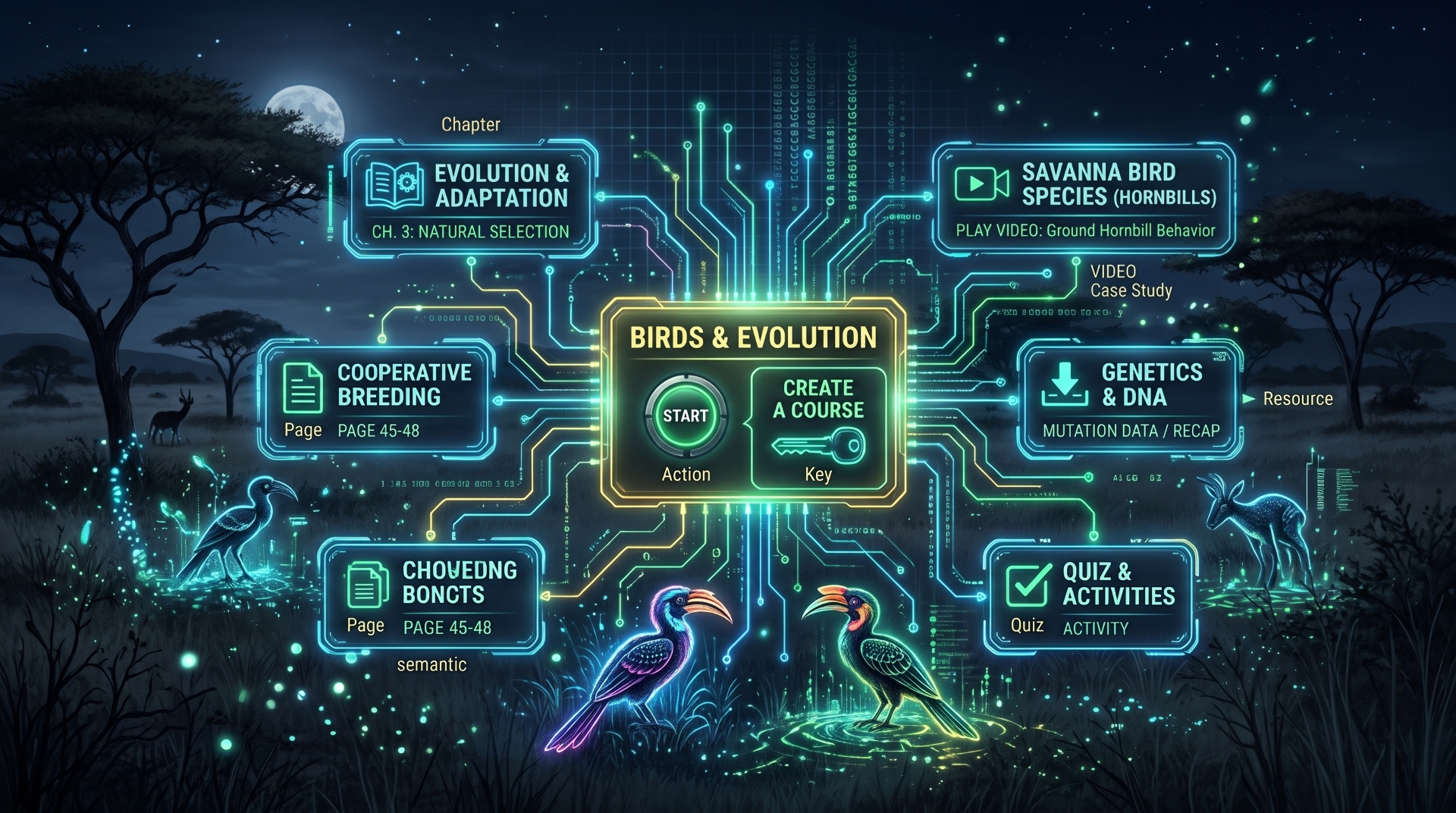
Active what?
A map helps us see where we are and where we might go. A knowledge map does something similar for our ideas: it makes connections visible, reveals gaps and gives shape to things that can be difficult to understand as a list.
Chisimba’s Active Knowledge Map (AKM) starts with that familiar experience. It looks and behaves like a mindmap or concept map application. You can create nodes, build branches, rearrange ideas and add notes. You can explore a subject before committing to a structure, or step back from a detailed project to see the whole.
But the word active points to a further ambition. What if the map could help us act on the ideas it contains?
Giving ideas meaning
In an ordinary map, a node might say “Introduction”, “Grass identification” or “Review questions”. A person can interpret those labels, but the application does not necessarily know what they represent.
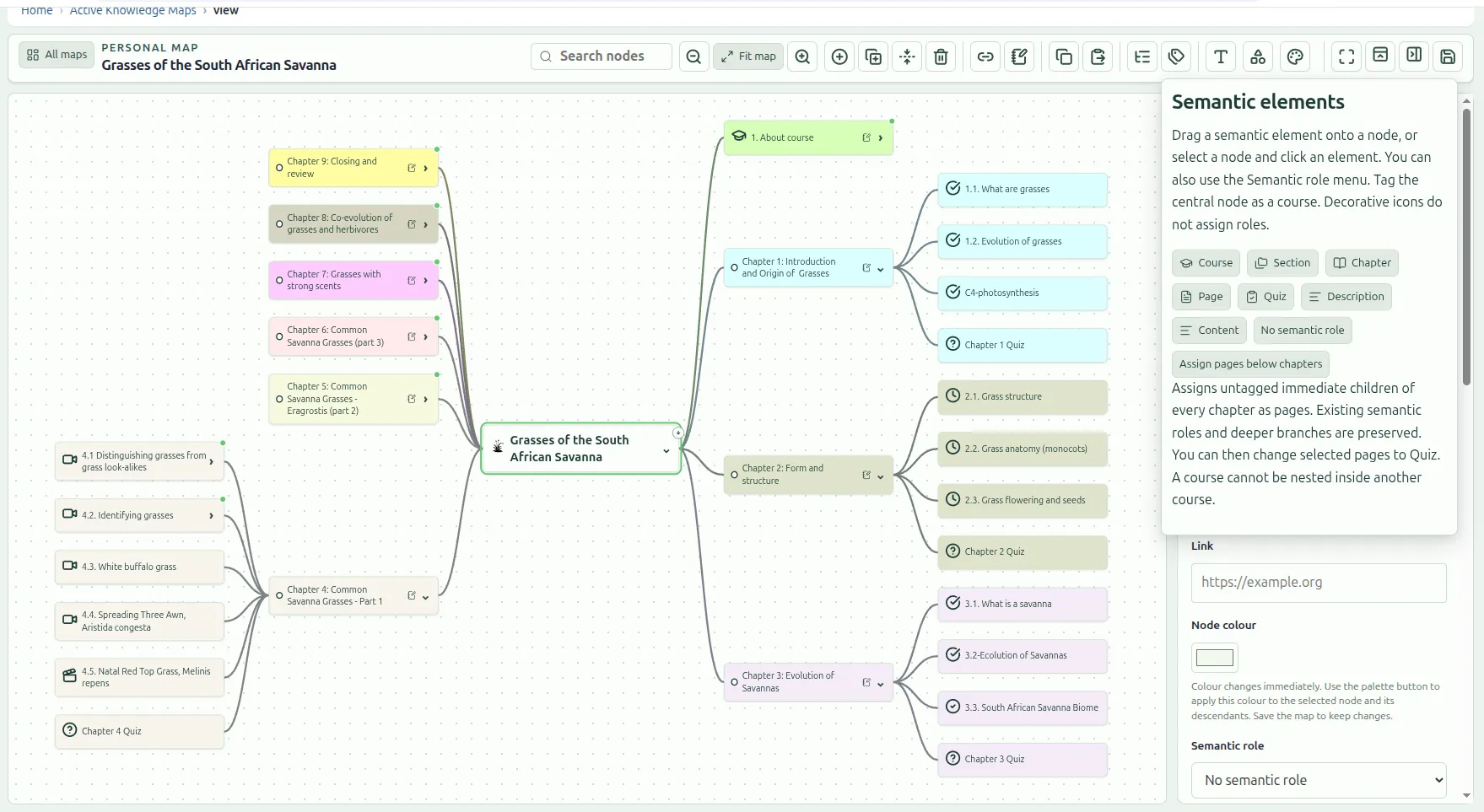
AKM introduces semantic elements: ways of identifying what a node means in the work you are doing. A node can represent a course, a section, a chapter, a page or a quiz. These roles are separate from its appearance. An icon can decorate an idea; a semantic role gives the application something meaningful to work with.
That distinction creates a bridge between thinking and doing. The map remains a flexible space for exploration, while selected parts of it acquire enough structure to support an action.
The same principle can extend well beyond learning content. Depending on the activity, a node might eventually represent a task, a research question, a resource, an event or a decision.
The first active element: from map to course
Course creation is the first practical expression of this idea.
An author can develop the shape of a course visually, identify the roles of its nodes and use that structure to create a course outline in Chisimba. The relationships explored on the map become a starting point for chapters, pages and quizzes.
The purpose is to make the transition from planning to authoring easier. A map is useful for deciding what belongs together, what should come first and what is missing. The course editor is where the detailed teaching material can take shape.
A quiz node can also hold source material for AI-assisted question generation, creating a bank of questions for human review. This begins to show how a node can carry both an idea and the material needed to act on it. This has already been used in my Grass course to create stage-gate quizes.
Course creation is therefore a first use of AKM, rather than its defining limit. The broader concept is a visual workspace in which meaning and relationships can lead to useful actions.
AI as a first pass
One planned direction is AI-assisted first-pass content generation.
An author might establish the purpose, sequence and scope of a course in the map, attach relevant source material and ask AI to propose an initial explanation, activity or set of questions. The map could provide context about how each contribution fits into the larger learning experience.
“First pass” is an important qualification. In keeping with our ethical approach to AI, a human must provide the second pass: checking accuracy, questioning assumptions, identifying omissions and bias, respecting sources, and making the material appropriate for its learners.
A fluent draft is not necessarily a sound explanation. Nor does a collection of generated pages automatically make a coherent course. The author’s knowledge, judgement and responsibility remain central.
Used this way, AI can help get work started while leaving educational decisions with the people accountable for them.
Bringing existing work back into view
Another possible direction reverses the journey.
Instead of creating a course from a map, AKM could pull an existing course into a map for review, expansion and recreation. Material that has grown over time could become visible as a whole again.
That could help an author ask useful questions. Are some chapters overloaded while others are thin? Does an activity prepare learners for what follows? Are important concepts introduced early enough? Where are there repetitions, gaps or opportunities for a different approach?
The map could become a space for planning a revised version before making changes to the course itself. Bringing work back into view would make AKM useful throughout its life, including when it needs rethinking.
From a shared idea to shared work
Project planning offers another natural possibility.
Many projects begin as a map of intentions: things to investigate, people to involve, resources to prepare and outcomes to achieve. Some of those ideas eventually become tasks.
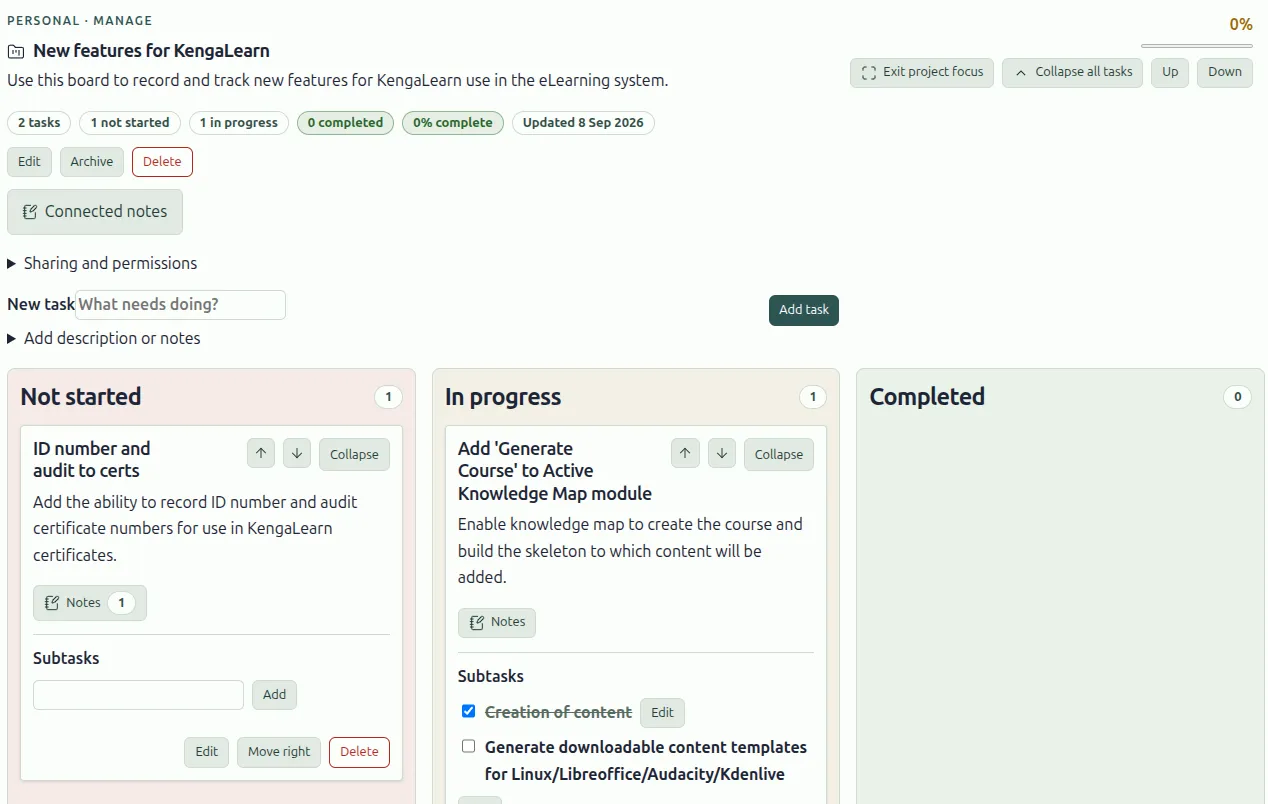
A future connection between AKM and Chisimba’s Kanban tools could help carry selected nodes into a working task board. The map would preserve the wider purpose and relationships, while the board would support the day-to-day flow of work.
A team could move between two useful perspectives: What are we trying to achieve, and how does it fit together? and What needs attention next?
Other possibilities worth exploring
The most promising uses may come from treating AKM as a meeting place between knowledge and activity. A few possibilities stand out:
-
Research and evidence mapping. Connect questions, claims, sources and unresolved issues. A useful future action might turn a gap in the evidence into a research task, while retaining the connection to the question that prompted it.
-
Learning pathways. Identify prerequisites and alternative routes through a topic. Authors could plan different journeys for beginners and experienced learners without losing sight of the knowledge they share.
-
Collaborative curriculum review. Map learning outcomes against explanations, activities and assessments. Missing connections could prompt discussion about what learners actually have opportunities to practise and demonstrate.
-
Resource planning. Identify where a photograph, field observation, video, dataset or written explanation is needed. Those nodes could support a production plan or, eventually, a downloadable folder and file structure for an author’s preferred tools.
-
Learner-created maps. Invite learners to show how their understanding develops, attach evidence and identify questions they still have. The map could support reflection and conversation as well as the organisation of teaching material.
These are directions to explore, rather than a list of features already available. They share one principle: an action should remain connected to the idea, purpose or question that gives it meaning.
A map that stays useful
Planning tools can become separated from the work they helped to start. The outline is filed away, the diagram becomes outdated, and attention shifts elsewhere.
The ambition for Active Knowledge Maps is to keep that visual thinking space useful: as a place to begin, to organise, to act, and later to reconsider.
Course creation is the first step. The larger opportunity is to help people move thoughtfully between understanding something and doing something with that understanding—while keeping human judgement at the centre.
***
Chisimba — an open-source, modular platform for learning, knowledge management and human-centred innovation.
Chisimba is a managed by Kenga Solutions (Pty) Ltd, a company based in Hoedspruit, Limpopo, South Africa with a deep focus on teaching-and-learning about nature and the bush.
Tags: knowledge map