Chisimba and ethical AI: Helping educators do more
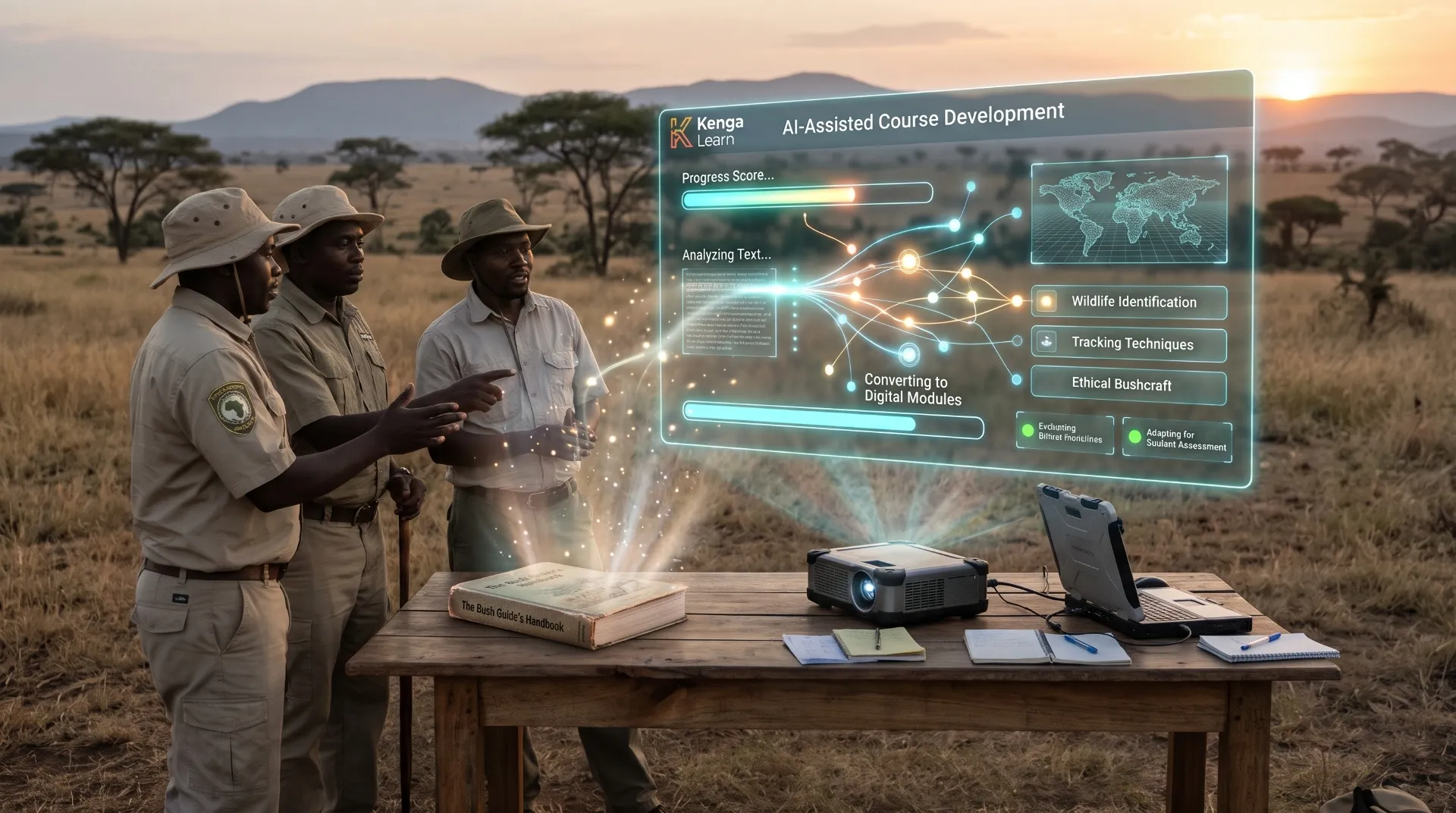
Artificial intelligence should make good education easier to deliver, not remove educators from the learning process.
Artificial intelligence offers extraordinary possibilities for education. It can help develop learning materials, create assessments, organise knowledge and reduce repetitive work. But there is an important distinction between using AI to support educators and allowing AI to take control of education.
At Kenga Solutions (Pty) Ltd, we believe that AI should remain a tool in the hands of people. Educators must be able to guide its work, evaluate its outputs and retain responsibility for what students learn. This philosophy is shaping how we integrate AI capabilities into Chisimba, our open-source, modular platform for learning, publishing and knowledge management.
Here are three practical examples.
1. Creating multiple-choice assessments with AI
Preparing good multiple-choice questions takes time. A well-designed question should assess meaningful understanding rather than simply test whether a student can remember an isolated fact. The incorrect answers should be plausible, the correct answer unambiguous, and the question appropriate to the level of the learner.
Chisimba uses AI to help generate multiple-choice questions from educational content. Instead of writing every question from scratch, educators can use AI to develop an initial set of questions and answers, then review, improve and select those that are appropriate. This is typically done by ingesting text, which might be a lecture script, or a chapter from the learning manual.
A learning unit about ecology might generate questions about food webs, competition, adaptation or ecosystem processes. The instructor remains responsible for ensuring that the questions are scientifically accurate, educationally meaningful and aligned with the intended learning outcomes. Once the questions are approved, they go into a question bank from which questions can be drawn randomly in future. AI provides a starting point. Human expertise determines what is suitable for teaching and assessment.
2. Turning a book into a structured course
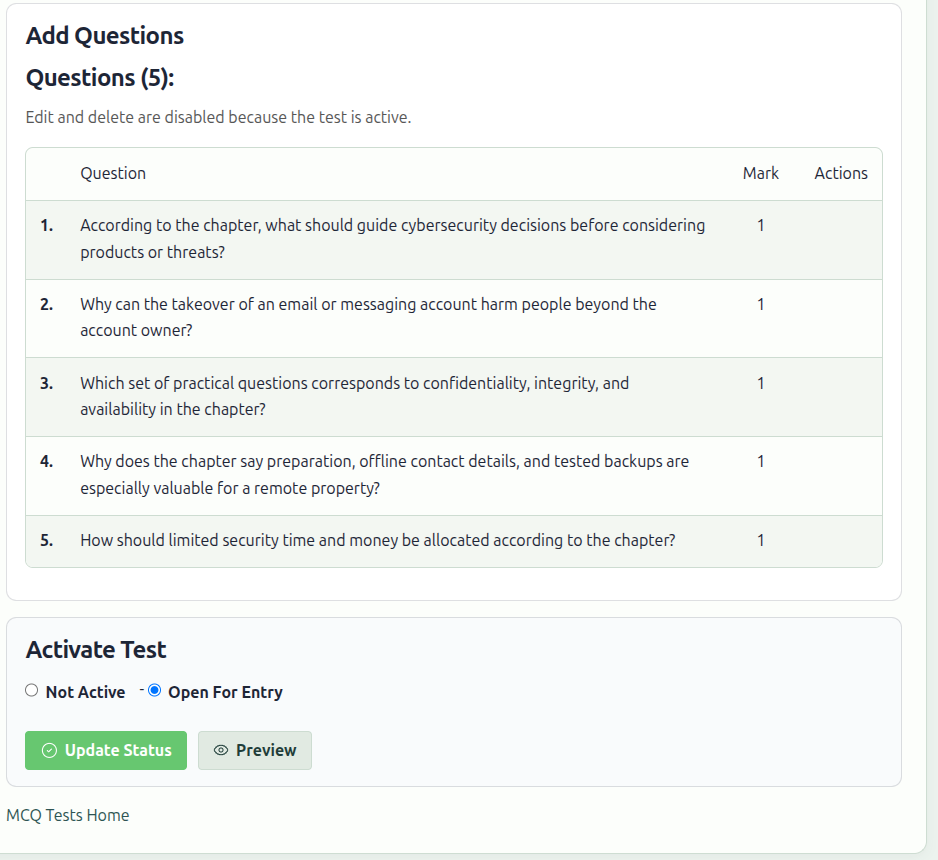
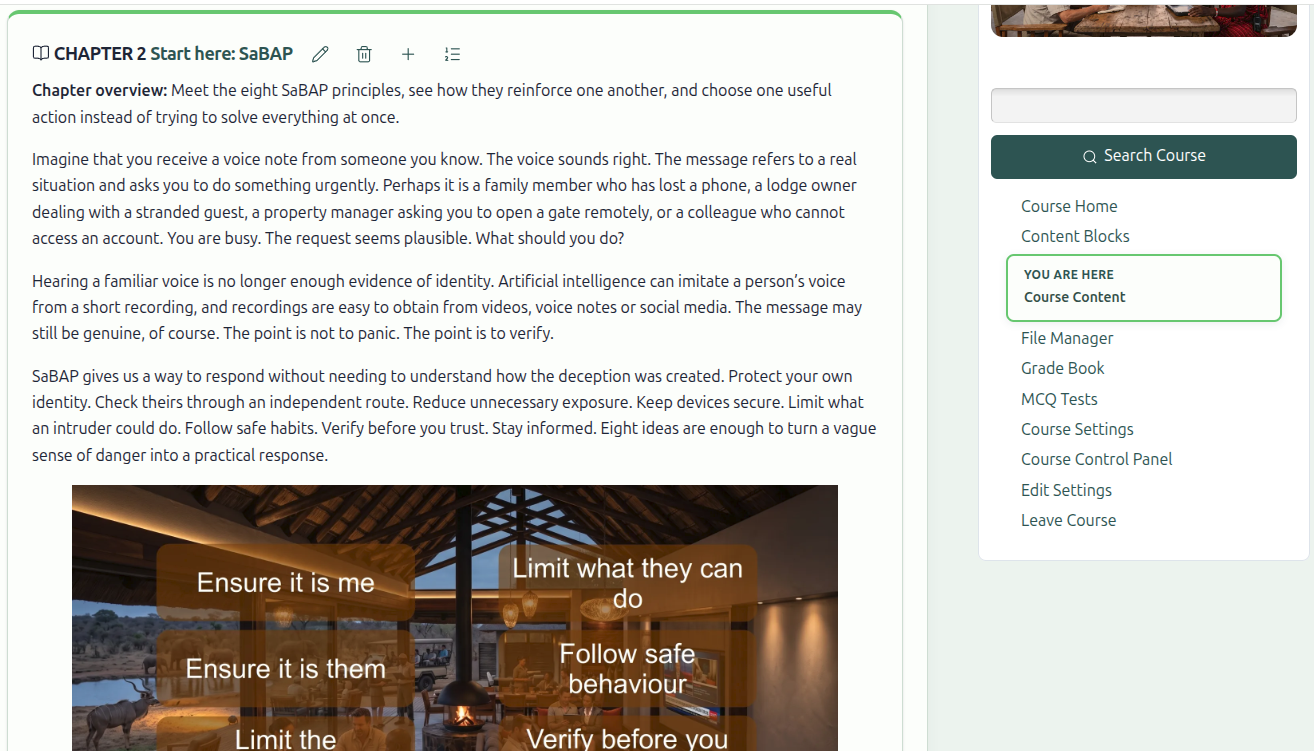
One of our practical experiments with AI-assisted course development is a cybersecurity course within Kenga Learn, which runs on Chisimba. I had a book that I had developed when I was working on cybersecurity, and it had been published on Amazon and was a bit out of date. I took the raw material of the book, and updated it, making it focused on nature tourism.
I then started with this book as the source material, a Chisimba AI module was developed and used to assist in organising the content into a structured learning experience. Following from the previous example, multiple choice questions were created from the chapter content.
This illustrates an important possibility: substantial educational resources can become the foundation for organised online courses without requiring educators to build every component manually. AI can help identify themes, organise topics, develop explanatory material and suggest learning activities. But transforming a book into a course requires more than extracting information.
A good course needs a coherent learning sequence, suitable activities, opportunities to practise, and ways to assess understanding. The role of the educator is to evaluate the structure, verify the material, establish the learning outcomes and decide how the content should be presented. There is also an essential ethical and legal consideration: source materials must be used with appropriate permission, and their origins must be acknowledged.
AI can accelerate course development, but it does not eliminate the need for instructional design, subject expertise or respect for intellectual property. Fortunately, in this example, the IP was already mine.
3. Creating assessments from learning guides
Many training organisations already possess substantial collections of learning guides, manuals and instructional materials. These documents often contain much of the knowledge that students are expected to acquire. Yet developing assessment activities from them can require considerable additional work.
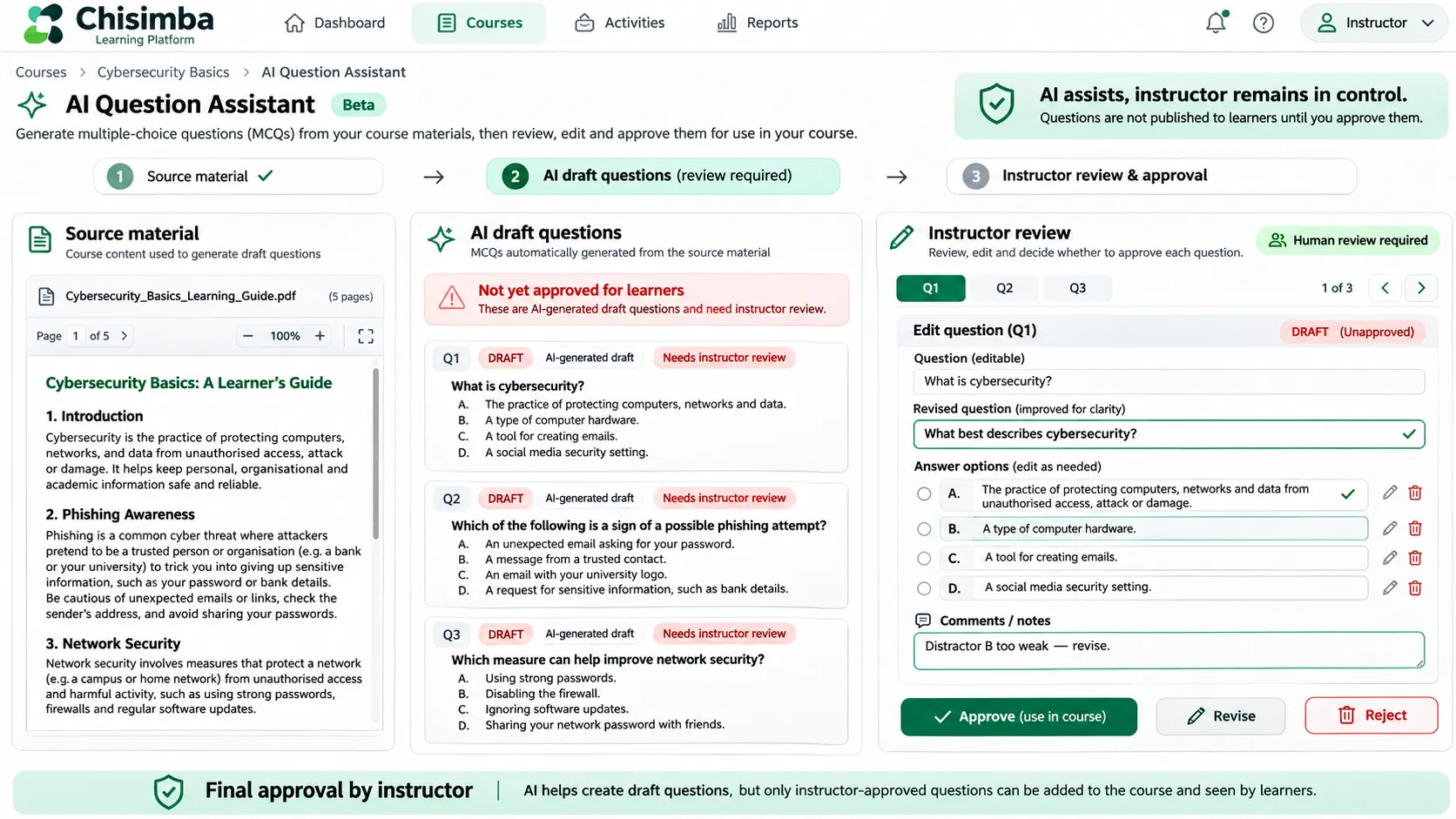
Chisimba's AI-assisted workflows provide opportunities to turn these existing materials into draft assessments.
A learning guide can become the starting point for questions that test understanding, application and interpretation.
This is particularly valuable in vocational and professional education, where assessment needs to remain aligned with established learning outcomes and prescribed materials.
AI can help educators prepare assessment resources more efficiently, but the resulting questions still need to be checked for accuracy, fairness and relevance. The goal is not to generate as many questions as possible. The goal is to help educators develop better assessments with less repetitive preparation.
Ethical AI requires meaningful human control
The ethical use of AI involves more than selecting an AI model or adding a disclaimer. It requires thoughtful decisions about how AI is used, what information it receives, how its outputs are evaluated and who remains accountable. Our approach is guided by several principles:
- Human oversight: Educators retain control of educational decisions and the materials students encounter.
- Transparency: AI-assisted processes should be identifiable rather than presented as entirely human-generated work.
- Accuracy: Generated materials must be checked for factual errors, misleading explanations and inappropriate questions.
- Privacy: Personal and educational information must be handled responsibly.
- Fairness: AI outputs should be evaluated for bias, accessibility and suitability for different learners.
- Accountability: Responsibility for educational quality remains with the organisation and its educators.
These are not simply technical issues. They are questions about the kind of education we want to provide.
More time for the human side of education
AI is particularly useful when it helps people spend less time performing repetitive tasks and more time doing things that require human experience and judgement. For educators, that can mean more time explaining difficult concepts, mentoring students, providing feedback and creating meaningful learning experiences. For organisations, it can mean developing learning resources more efficiently and making better use of the knowledge they already possess. Chisimba provides a modular foundation for bringing these capabilities into a broader learning environment.
We don't want AI to replace educators. We want AI to help educators become more effective.
That is the kind of artificial intelligence we believe belongs in education.
****
Chisimba — an open-source, modular platform for learning, knowledge management and human-centred innovation.
Chisimba is a managed by Kenga Solutions (Pty) Ltd, a company based in Hoedspruit, Limpopo, South Africa with a deep focus on teaching-and-learning about nature and the bush.